Glantz Et Al Annual Review of Public Health 2018
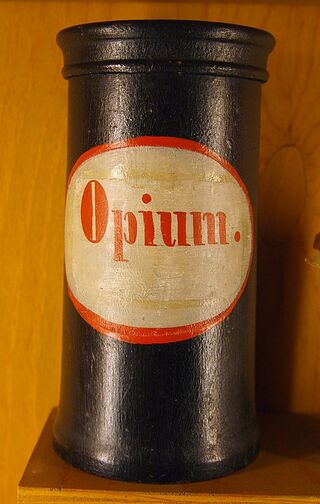
Opium Apothecary Jar
Source: Bullenwächter, Wikimedia Commons/Public Domain
"An object of mingled horror and pity…with yellow pasty face, drooping lids and pin-point pupils…the wreck and ruin of a noble homo," he was a slave to this "burning poison," writes Dr. Watson, of Sherlock Holmes fame, in Sir Arthur Conan Doyle's The Man with the Twisted Lip (1891). Watson, sent to retrieve his patient from an opium den, credits the homo'south habit to his having read Thomas de Quincey's Confessions of an English Opium-Eater (1886 edition, Project Gutenberg).
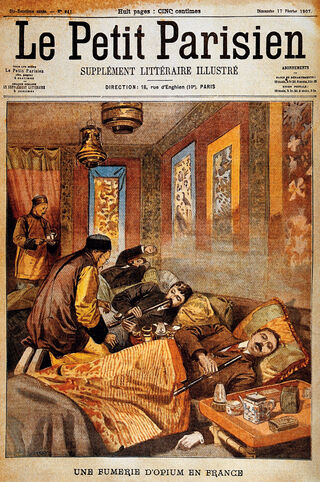
An opium den in France, 1907
Source: Pictures from History, Bridgeman Images, used with permission.
This account, though, hardly condones "the Circean spell of opium." Though de Quincey (1785-1859) describes initial feelings of "cloudless serenity" when he, as a xix-twelvemonth-quondam educatee, took a tincture of opium for an intractable toothache, he reveals that over time his total-blown opium habit led to "suicidal despondency, anxiety and gloomy melancholy," "chasms of sunless abysses," and "moral and spiritual terrors" that drove him nearly to madness. He had such a "sense of incapacity and feebleness" that he could "not even attempt to rise."
Opium is a natural substance derived from the poppy plant. It can exist smoked, injected intravenously, or taken orally in pill form. Morphine and codeine are among the active ingredients in opium (Brownstein, Proceedings of the National Academy of Sciences, The states, 1993). There is prove that opium was known in prehistoric times (Alam et al ACS Chemical Neuroscience, 2019). Past the eighth century A.D., opium had been introduced to Bharat and China. Alchemist Paracelsus (16th century) experimented with opium in alcohol that led to laudanum for medical utilise (Alam et al, 2019). Reports of drug corruption and tolerance surfaced by the 16th century (Brownstein, 1993).
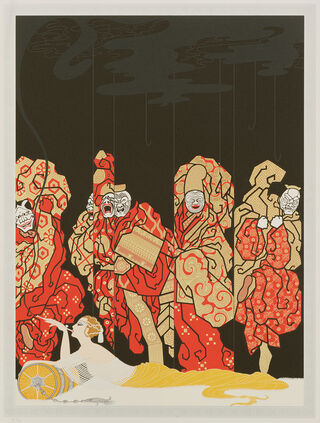
Opium (Mah Jongg Suite) by French artist Erte, 1985.
Source: Copyright Sevenarts Ltd., Artists Rights Society (ARS), NY 2020. Bridgeman Images, used with permission of both ARS and Bridgeman images
Opium addiction was particularly severe among the Chinese past the mid-17th century once tobacco smoking was banned (Brownstein, 1993) and continued to increase over the late 18th and early 19th centuries as drug lords from Uk flooded the Chinese markets with opium they had procured from India in exchange for Chinese tea (Pomeranz, NY Review of Books, 6/half dozen/xix). Past the mid-19th century, in that location are estimates that upwards to 12.5 million Chinese became addicted. In an attempt to stop this opium merchandise, the Chinese government imposed astringent merchandise restrictions on the British. Uk, which received huge revenues from this illegal opium trade, fought the so-called Opium Wars (1839-1842 and 1856-1860) with Communist china to maintain this lucrative commerce (Pomeranz, 2019). Ultimately, during this "Century of Humiliation," China capitulated and allowed the legal trade of opium, leading to the eventual refuse of the Qing Dynasty (Britannica.com).
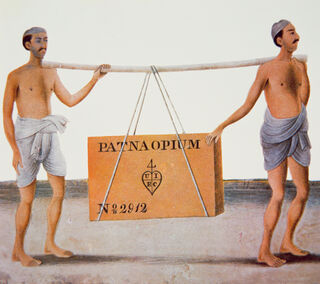
Opium from India, bound for Red china, by British; 19th century
Source: Bridgeman Images, used with permission. Peter Newark Historical Pictures.
One time a person is exposed to opiates repeatedly, he or she will develop tolerance (requiring a higher dose for the same effect), physical dependence that involves withdrawal symptoms (east.m. chills, indisposition, cramps, diarrhea, nausea, vomiting, dysphoria, feet, seizures) upon sudden discontinuation, and even hyperalgesia (increased pain), all affected past the opiate'south potency and road of administration (Volkow et al, Almanac Review of Medicine, 2018). About half of those exposed to opiates have adverse effects, including dry mouth, nausea, sedation, dizziness, rashes, and constipation (Volkow et al, 2018).
Significantly, tolerance to the analgesic and rewarding effects develops sooner than tolerance to respiratory depression, and dose escalation to attain the same furnishings can lead to overdose (Volkow et al, 2018). Clinicians can minimize overdose risk by prescribing the everyman effective daily dose, using short-acting formulations, and fugitive concomitant use of benzodiazepines (Chua et al, JAMA Pediatrics, 2020). The nigh serious adverse event is, of class, the evolution of addiction. Over time, chemists take developed many semisynthetic and constructed compounds derived from opium, including heroin and oxycodone, as well as antagonists (east.chiliad. naloxone).
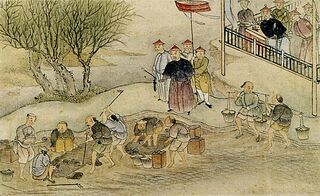
Commissioner Lin and the Destruction of opium in Cathay in 1839
Source: "Chinese artist"/Wikimedia Commons, Public Domain
While tolerance and physical dependence are "common and expected consequences," regardless of the type of opiates or patient variables, addiction is less common and develops over fourth dimension (Volkow et al, 2018). Habit is a chronic disorder that disrupts, i.east., hijacks, brain circuits involved in reward and motivation, executive control, and emotional processing and leads to the addicted person's preference for immediate rewards at the expense of "prioritizing long-term benefits" (Volkow and Boyle, American Periodical of Psychiatry, 2018). Though genetics accounts for about half of the risk for developing an addiction, a person's biological and psychological brand-upwardly interacts with environmental factors (Volkow and Boyle, 2018). Addiction is the term used specifically to describe compulsive preoccupation and drug-seeking behavior despite negative consequences.
- What Is Addiction?
- Discover counselling to overcome addiction
It is hard to predict who will develop an addiction later exposure to an initial opioid prescription. Adolescents who are prescribed an opiate, most usually hydrocodone, for dental pain (e.g. wisdom teeth extraction) (Hudgins et al, Pediatrics, 2019; Schroeder et al, JAMA Internal Medicine, 2019) are vulnerable because their brains are still evolving and more than "neuroplastic" than adult brains, with greater emotional reactivity, impulsivity, and less power to cocky-regulate (Volkow and Boyle, 2018). This initial "safe" experience of pain relief may prime number them for minimizing whatever perceived future risk (Miech et al, Pediatrics, 2015).

Jules Pascin, "Two Young Girls," 1915.
Source: Barnes Foundation Collection/Public Domain
Gamble factors include current or past substance use disorders, psychiatric co-morbidity (e.g. anxiety, low), a family history of these disorders, and female gender (Volkow et al, 2018; Richardson et al, Journal of Boyish Health, 2012; Harbaugh and Gadepalli, Current Stance-Pediatrics, 2019). In one commercially insured sample of over 1 1000000 adolescents kickoff receiving opiates, three out of k "transitioned" inside three years to long-term opiate apply, merely those with preexisting mental health atmospheric condition were "substantially more likely" to proceed long-term use (Quinn et al, JAMA Pediatrics 2018). Sometimes, those who are at college risk are more apt to receive a prescription in what is called "adverse selection" (Quinn et al, Pain, 2019; Richardson et al, 2012).
Addiction Essential Reads
Assessing how oftentimes misuse and addiction occur in this context of physician-prescribed medication for non-cancer patients is hard. Studies vary considerably in their design (Quinn et al, 2019). For example, some fail to assemble pertinent information on the dose, length, indication, effectiveness, age, or fifty-fifty family or psychiatric history (Miech et al, 2015). Many large-scale studies are based on questionnaires or retrospective chart review of insurance records on specific populations that may not have generalizability. Further, many studies use data of dispensed prescriptions, rather than those written or that reverberate bodily patient adherence. Of near 15,000 patients, ages xvi to 25, who received opiates after dental procedures, there was a statistically meaning increased adventure for persistent opioid use (Schroeder et al, 2019). Those requesting refills of the original prescription and continuing use for a longer total elapsing were specially susceptible to misusing opiates; the number of mail service-discharge prescriptions best predicted eventual misuse (Deviling et al, BMJ, 2018).
Employing multiple, sophisticated designs to adjust for confounding, Quinn, of the School of Public Health, Indiana University, Bloomington, and his colleagues used a sample of over 1.5 1000000 "opium-naive" Swedish adolescents and young adults (JAMA Pediatrics, 2020). They plant that those receiving opiates had, within five years, only a 1 to 2% greater absolute risk of developing substance-related morbidity than those who received anti-inflammatory medication. Given the common exercise of prescribing opiates for this age group, though, even this small absolute risk translates into substantial morbidity.

The cute only potentially deadly opium poppies.
Source: Rowan McOnegal/Wellcome Trust Collection/Attribution 4.0 International (CC past 4.0)
Bottom line: Opiate addiction remains a considerable public health problem in the U.Due south. Adolescents and immature adults are particularly vulnerable because areas of their encephalon involved in impulse control and self-regulation are still developing. Many who somewhen become addicted were given legitimate prescriptions for pain, often for dental procedures, only equally 19th-century adolescent Thomas de Quincey. Those most at gamble have a history of mental illness, previous substance abuse, or family history. It behooves clinicians who prescribe opiates to take a careful mental health history, avoid over-prescribing either dose or quantity, and remain cognizant of those who renew prescriptions.
Source: https://www.psychologytoday.com/intl/blog/the-gravity-weight/202009/the-opium-eaters
0 Response to "Glantz Et Al Annual Review of Public Health 2018"
Post a Comment