An Early Leader in Installation Art Was This Japanese Artist Known for Her Dots
Yayoi Kusama is arguably Japan'due south nigh famous living artist. Born in 1929, she is one of the few practising artists whose work spans the most important "isms" of the 20th century. At the same fourth dimension, her work is undeniably contemporary. For decades, her dazzling mirror and polka-dot infused installations, or "Infinity" rooms have enthralled audiences.
First adult in 1965, the mirrored interiors multiply and reflect, expanding outwards ad infinitum. This vertiginous, nearly hallucinatory experience has evolved to become trademark Kusama and feels incomplete without the now mandatory selfie in this always expanding universe of dots, lights and mirrors.
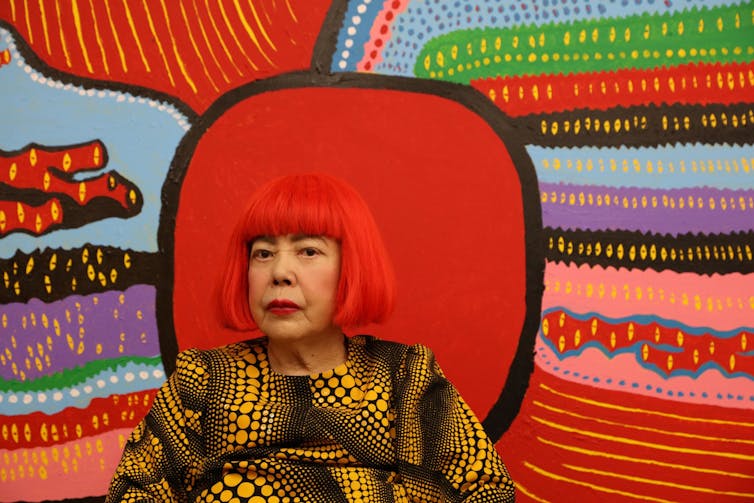
Subsequently an amazing 65 years of artistic output, a new survey exhibition of her work has just opened at Brisbane's Gallery of Modern Art (GOMA). Importantly, it provides a historical context to these rooms, tracing key strains in Kusama'south artistic development. Co-curated with the Singapore National Art Gallery, the exhibition cements GOMA'due south long association with the artist. Kusama's Narcissus garden (1966/2002) is a much-loved icon in the permanent drove. The scores of silvery mirrored balls provide endlessly reflective surfaces as they bladder serenely in GOMA's Watermall.
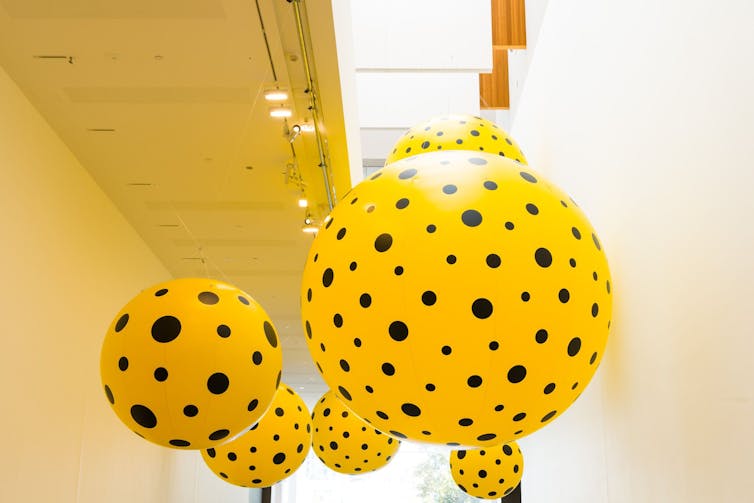
Kusama enthusiasts will exist delighted with new works created this year such every bit the enormous balloons floating mid-air in GOMA'due south long gallery. The balloons are coloured in Kusama's distinctive xanthous and black polka dots, welcoming the visitor to the exhibition with a weightless, ethereal presence.
It is well-nigh impossible to split up Kusama's life from her practice. Every bit a small kid growing up in Japan, she suffered hallucinations in the grade of fields of dots. These hallucinations accept connected throughout her life and the dots became a crucial recurring motif.
In 1958 Kusama arrived in New York via a short stay in Seattle and immediately immersed herself in the vibrant advanced artistic community, associating with Joseph Cornell, Donald Judd, Claes Oldenberg and Andy Warhol. It was a notoriously exciting and experimental decade, and Kusama's work chop-chop expanded beyond the canvas encompassing performance and manner design.
The exhibition is organised chronologically, making it possible to nautical chart Kusama's artistic development through the decades. Kusama was trained in Nihonga painting, a hybrid style combining traditional Japanese techniques and materials with 19th-century European landscapes. From 1951 until she left for the US in 1957, Kusama worked almost exclusively on these small works on paper, experimenting with watercolour, gouache and oil pigment. In these foreign and murky almost-landscapes, it is possible to find the embryonic germination of the dots and nets that were to come later.
Kusama'due south preoccupation with repetition and infinity comes to the fore with the "Infinity nets" series. Originally small paintings on newspaper, the nets grew, responding to the influence of Jackson Pollock and the abstract expressionists' exploitation of scale. The paintings are an optical sensation, expanding and contracting as if they are animate. With no clear starting time or finish, they throb and pulse, giving the impression they could extend forever, beyond the confines of the canvass.
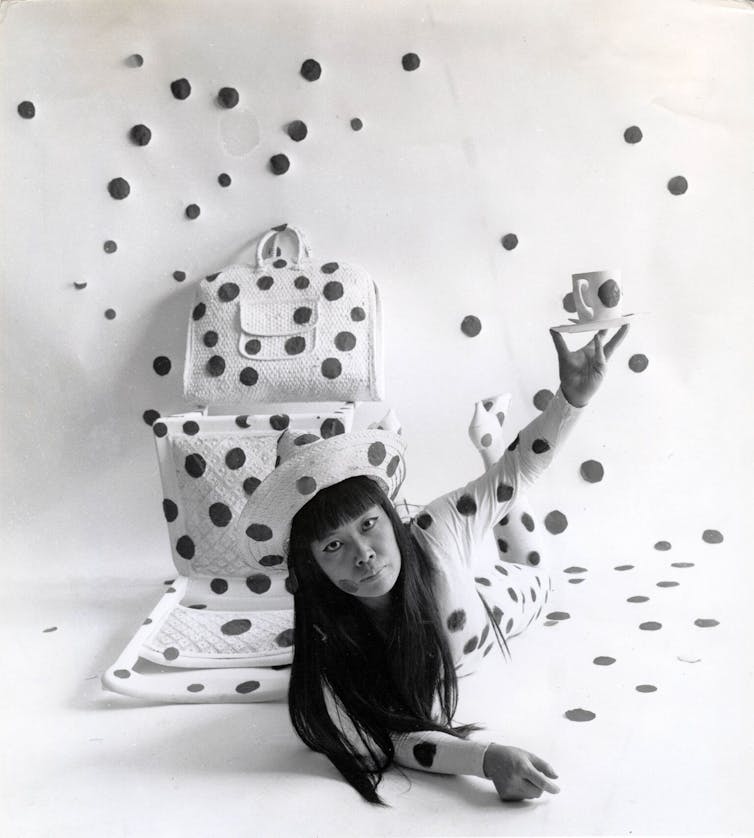
One of the nigh fascinating aspects to the exhibition are the photographs documenting her performances, or "Happenings" during the 1960s and early on 1970s. If Kusama's "Infinity" rooms anticipated today'south selfie civilization, there is something wonderfully nostalgic and utopian about these images.
Kusama was engaged in the social and political upheaval of the time, including anti-Vietnam war protests. In one photograph, a group of participants are shown nude protesting on Brooklyn Bridge, covered in her signature polka dots. In her autobiography, Infinity Cyberspace, Kusama recalls writing an open letter to President Richard Nixon, promising to "paint each other with polka dots" if he withdrew from Vietnam.
Kusama returned to Nippon in 1973, and has lived voluntarily in a psychiatric facility since 1975. Virtually forgotten past the New York fine art customs, her career was resurrected when she represented Japan at the 1993 Venice Biennale. It was during this period that yellow and blackness pumpkins emerged as an important new motif in her work.
As a child, her family had owned a nursery. Pumpkins were familiar and comforting, and a major part of her diet. The 1993 Venice installation is recreated in one of the centrepieces of the exhibition, The Spirits of the Pumpkins Descended into the Heavens (2015). The visitor enters a room that has been painted with her trademark pumpkin-inspired yellowish and black polka dots.
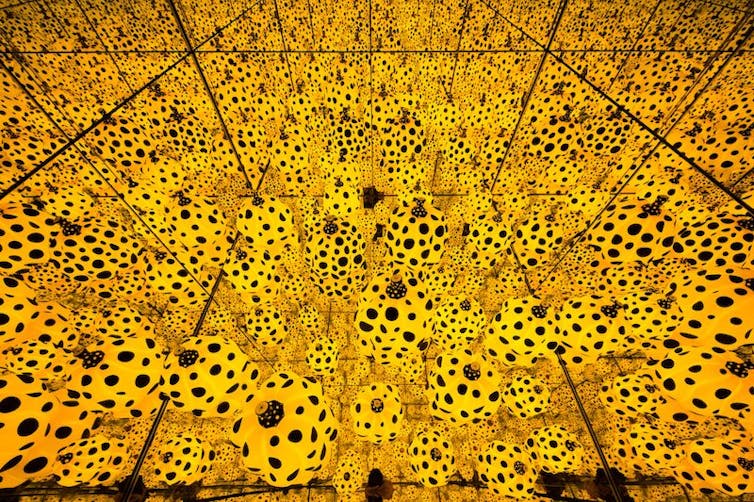
In the middle of a room sits a mirrored cube. A serial of pocket-sized peep-hole windows allows the visitor to gaze at the interior containing an array of pumpkin sculptures. The issue is startling. The mirrors reflect the pumpkins infinitely onward and outward, collapsing the boundary betwixt interior and exterior space.
Serial repetition returns in a recent series "My Eternal Soul". Bundled in a grid-like formation effectually the gallery walls, Kusama'south emphasis on repetition explodes with vibrant colour.
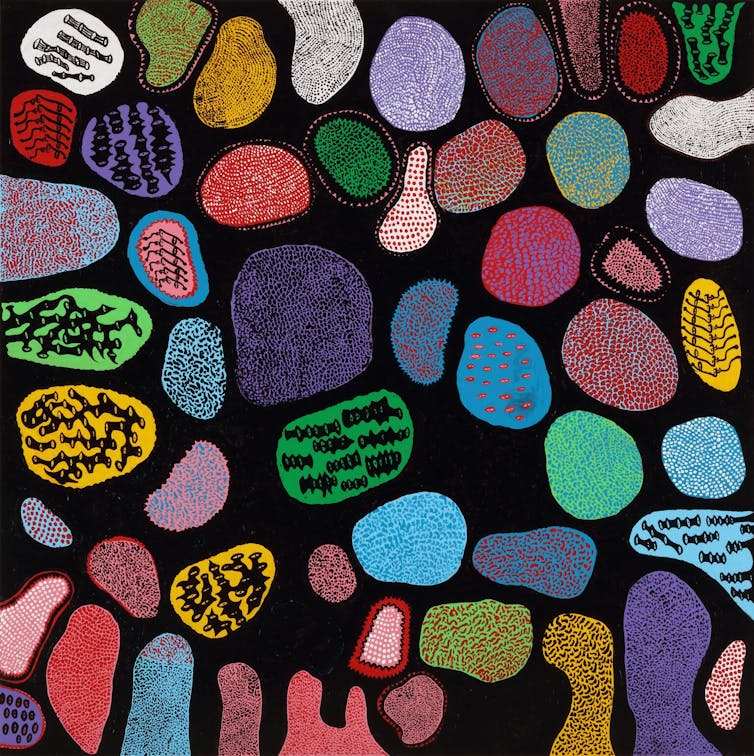
The sculptures placed in the heart of the room echo the organic shapes and forms on the canvases. The serial serves a strong reminder: even at 88, Kusama is even so introducing new various visual forms in her practice. The optical illusions are still there, emboldened through dynamic juxtapositions of color.
Yayoi Kusama: Life is the Eye of a Rainbow is at Brisbane'due south Gallery of Modern Art until 11 February 2018. The exhibition is gratuitous.
Source: https://theconversation.com/from-selfie-to-infinity-yayoi-kusamas-amazing-technicoloured-dreamscape-87076
0 Response to "An Early Leader in Installation Art Was This Japanese Artist Known for Her Dots"
Post a Comment